Every dealership has a key system. It might be a pegboard on the wall behind the reception desk. A lockbox in the service manager's office. A drawer full of envelopes. A combination of all three, plus a handwritten sign-out sheet that was current about six months ago.
For a small operation with a handful of vehicles and a team of three or four, these approaches can work well enough. The volume is manageable, everyone knows where things are, and when a key goes missing, it usually turns up within the hour. But as a dealership grows — more vehicles, more staff, more departments, more shifts — the manual approach hits a tipping point. And most dealerships do not recognise they have passed it until the symptoms are impossible to ignore.
Where manual tracking breaks down
The fundamental problem with manual key tracking is that it depends entirely on human compliance. Every person who takes a key has to remember to sign it out. Every person who returns a key has to remember to sign it back in. Every person has to use the correct hook, write legibly, and follow the process every single time — including on their busiest, most chaotic days.
In a perfect world, this works. In a real dealership on a Friday afternoon with three customers waiting, a trade-in arriving, and the service department running behind, it does not. The sign-out sheet gets skipped. The key goes on the wrong hook. Someone borrows a key "for just a second" and forgets about it. The system degrades quietly, one shortcut at a time, until it is functionally useless.
This is not a reflection of bad employees or poor management. It is simply the reality of manual systems under operational pressure. The process demands consistency from people whose job is to be responsive, flexible, and fast. Those priorities are in direct tension with the kind of meticulous record-keeping that effective manual key tracking requires.
The accountability gap
The most consequential failure of manual key tracking is the absence of a reliable audit trail. When a key goes missing from a pegboard, the question is always the same: who had it last? And the answer is almost always the same: nobody knows for sure.
The sign-out sheet — if it was used — might show that a salesperson took it at 10:30 on Tuesday. But did they return it? The sheet does not say, because nobody signed it back in. Did someone else take it after that? Impossible to tell. The key's history between Tuesday morning and the moment someone noticed it was missing is a complete blank.
This gap creates two problems. The immediate problem is operational: somebody has to find the key or order a replacement. The deeper problem is cultural. When there is no accountability, people stop taking key management seriously. Why bother signing out a key if nobody checks the sheet? Why return the key to the correct hook if nobody will notice? The system becomes a formality that everyone performs loosely and nobody trusts — which means it fails precisely when it matters most.
The scaling problem
A dealership with 30 keys and five employees can manage manual tracking with discipline. A dealership with 200 keys, 25 employees, and separate sales and service departments is operating in a fundamentally different environment. The number of key transactions per day increases exponentially with headcount and vehicle volume, and each transaction is an opportunity for the manual system to break.
Multi-rooftop operations face an even steeper challenge. Keys that move between locations — loaner vehicles returned to the wrong site, trade-ins arriving at one location and being prepped at another — create cross-location tracking requirements that no pegboard was designed to handle.
The irony is that dealerships often recognise the need for better systems in every other area of their business. Inventory management is digital. Customer records are in a CRM. Financial reporting is automated. But the keys to hundreds of thousands of francs worth of inventory are managed from an unlocked room. The only tracking tool is a pen and a clipboard. The gap between how dealerships manage their data and how they manage their physical keys is striking.
What changes with electronic key management
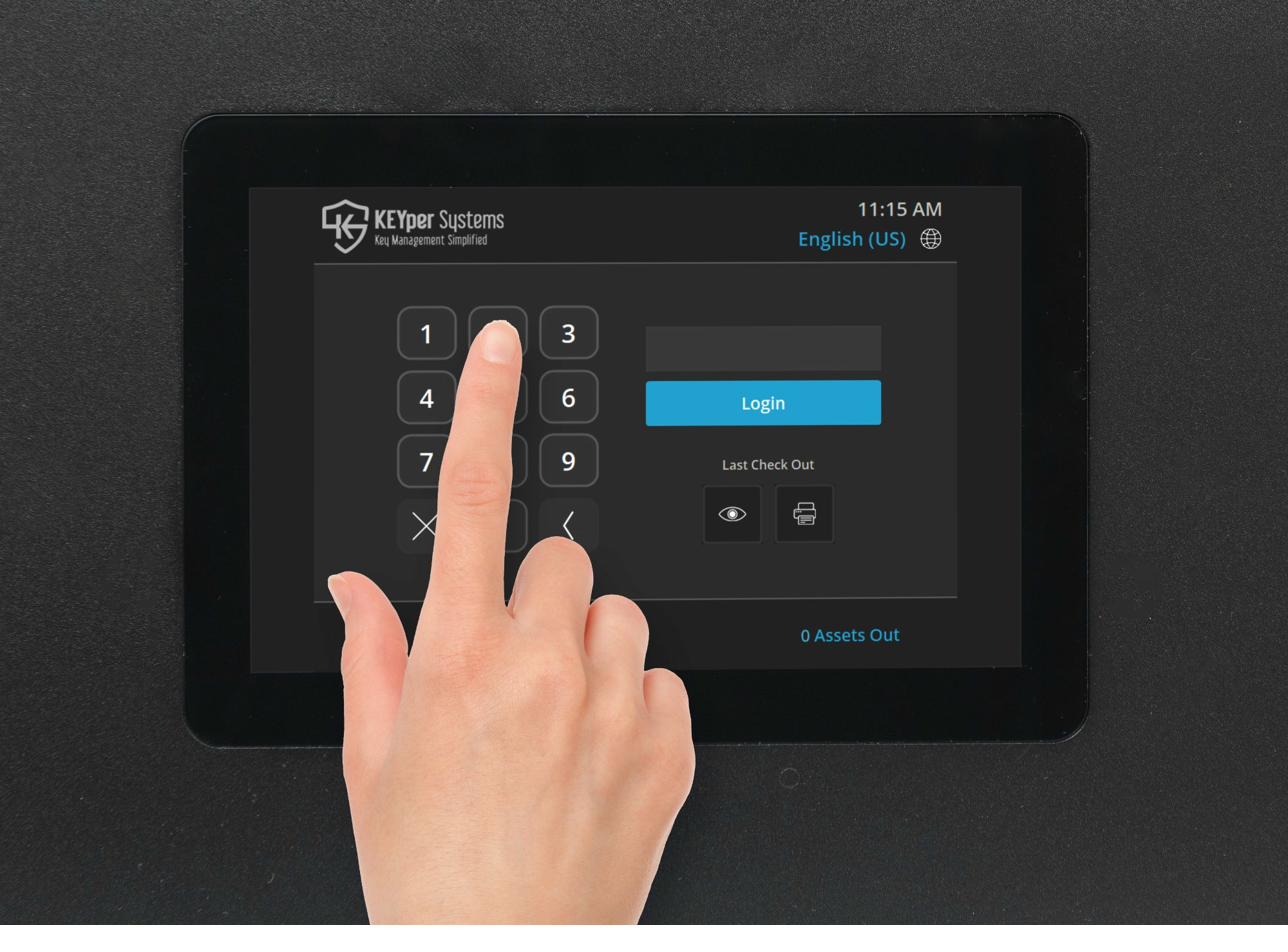
The shift from manual to electronic key tracking is less about the technology and more about what it enables. The cabinet itself is just a locked box with individually controlled key slots. The real value is in the three things it automates: authentication, logging, and alerting.
Authentication means every key transaction requires the user to identify themselves — by PIN, card, fingerprint, or a combination. There is no "someone in service probably took it." There is a name and a timestamp, every time.
Logging means every transaction is recorded automatically, without depending on anyone to write it down. The system creates a complete, unbroken chain of custody for every key, from the moment it enters the cabinet to the moment it is returned. That record is stored digitally and available on demand — for management review, for insurer requests, or for incident investigation.
Alerting means the system can proactively flag problems: a key that has been out too long, a key that was accessed outside of normal hours, a key that has not been returned at the end of a shift. Instead of discovering a missing key when someone needs it, the system shows before it becomes a crisis.
None of this is conceptually groundbreaking. It is the same logic that drives access control systems in office buildings, IT asset management, and pharmaceutical inventory tracking. The automotive industry is simply catching up to a practice that other industries adopted years ago.
The tipping point
There is no universal threshold at which a dealership needs to move beyond manual tracking. It depends on key volume, staffing patterns, vehicle values, and the tolerance for operational friction. But there are reliable indicators that the tipping point has arrived.
The dealership replaces more than one or two keys per month. Staff regularly spends time searching for keys that should be on the board. Nobody can confidently answer the question "who had this key last?" for any given vehicle. The insurer has asked about key storage practices and there was not a strong answer. There has been — or come close to having — a vehicle leave the lot without authorisation.
If any of these are familiar, the manual system has already failed. What remains is the decision about what to replace it with.
Making the evaluation
The right approach is to evaluate the actual situation, not to respond to a sales pitch. A practical assessment starts with counting the keys, reviewing how much time staff spend on key-related problems, pulling the replacement key invoices for the past year, and checking what the insurer expects. If the numbers support the investment, the decision becomes straightforward.
For some dealerships, the answer will be a clear yes. For others, tighter manual controls may be the right step for now. The point is not to sell a system — it is to make sure the decision is being made with open eyes, based on real data, rather than continuing with a process that has quietly stopped working.